Leonardo Bindilatti é o vencedor da Bolsa de Criação OUT.RA para 2023. Co-fundador da Cafetra Records, baterista dos incríveis Putas Bêbadas, metade dos queridos Iguanas, solo master beatmaker enquanto Rabu […]

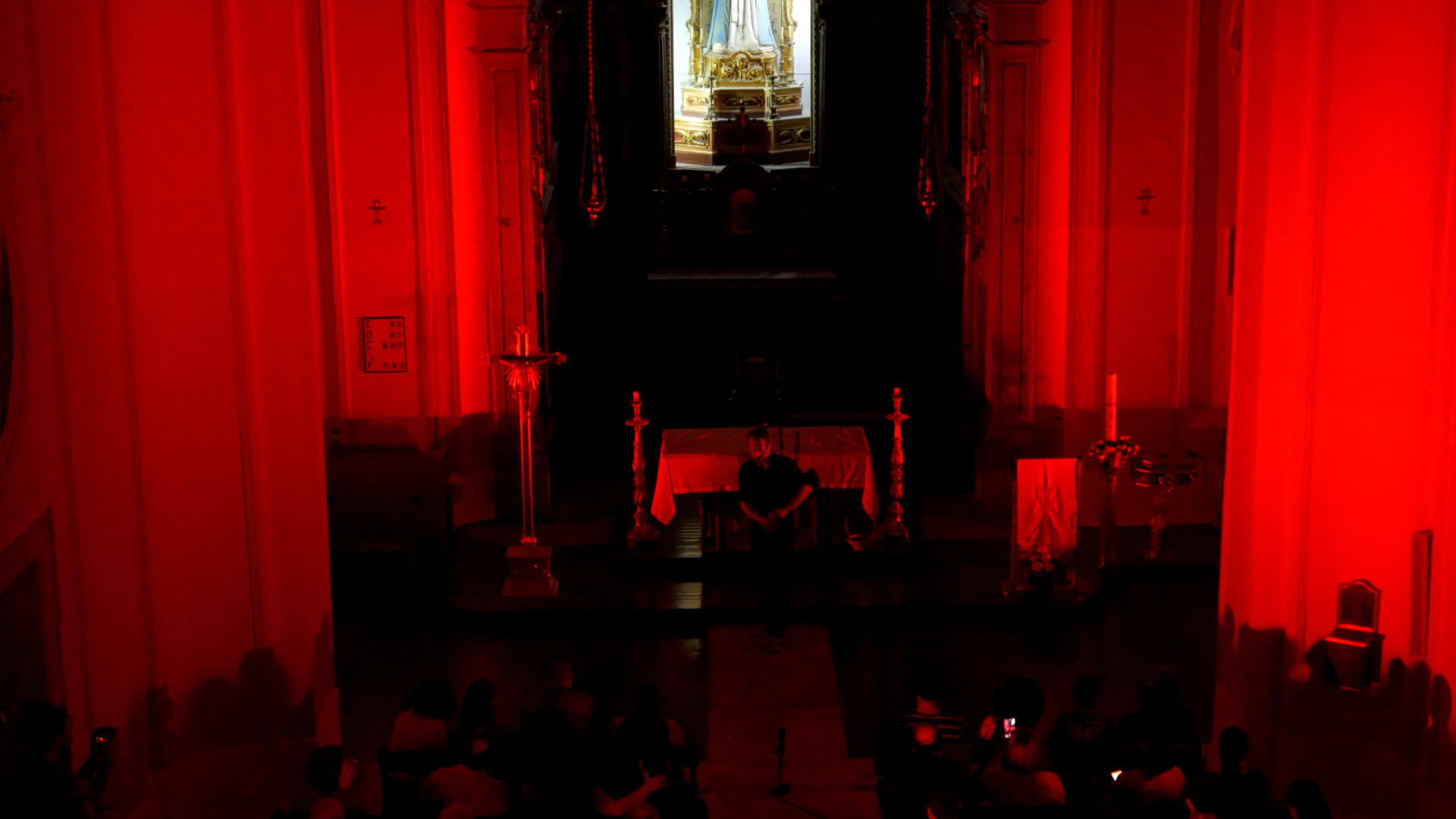
Erwan Keravec is a Breton piper whose eclectic path ranges from traditional to contemporary music and improvisation. This encompasses playing solo music written for him by a wealth of contemporary composers, leading a piper quartet, improvising with key figures of european jazz and writing and playing music for modern dance and theatre companies. He performed at the Nossa Senhora do Rosário church in Barreiro on July 2019, and after his soundcheck we took the chance to interview him. You can read that interview below.
Hi Erwan, can you tell us more about your background as a musician and how you chose the bagpipes as “your” instrument?
I grew up with traditional music. My parents were dancers in the traditional Brittany style, with traditional music from Brittany, and when I was a child the first instruments I heard were the bagpipes and the bombarde, a kind of oboe. I learned to play the bagpipes in their traditional context for marching and dance. One time I played with an orchestra in Bern with bagpipes, snare drums and the bombarde and we met a jazz big band. That was when I improvised with the bagpipes for the first time, and after that I decided to focus on improvised music, even though my background is really in traditional music.
Have you tried other instruments in the bagpipe family, from other musical traditions? How would you compare them to your own?
Two years ago I played in a trio with three bagpipes: one from Algeria, another from Iran and mine, from Brittany. And my idea at first was that the three bagpipers would play solos, and when we were practicing of course we tried each other’s bagpipes, and it wasn’t very easy (laughs). It’s not the same fingering, of course the system of breathing is the same, but the fingering is totally different, so it’s not very easy to play other kinds of bagpipe…I focus on the one from Brittany exclusively.
You’ve been touring with your ‘Revolutionary Birds’ trio (with Wassim Halal and Mounir Troudi). How did this collaboration come about?
Revolutionary Birds began as a commission by two festivals, one in Beirut, Irtijal, and another in Paris, la Voix est Libre, and the idea the two directors had was to mix music from Iran, Lebanon, Tunisia and Brittany. It was not our idea at first, but after that the three of us decided to take this idea and to tour with it. For me this is different from what I usually do - when I play solo, in duo, trio, etc, it’s always my idea, but this was the first time I played in someone else’s idea. At the beginning I was like “ok, what kind of band is this”! We work a lot with percussion right from the start of the composition, so the structure of our music is all based on the bagpipe and the percussion and the voices come after. But it’s not what I usually do - usually I take an idea from beginning to end, so this is different for me.
How have the trios’ performances been received so far? Have you been getting good receptions by the audiences?
Yeah yeah, in all kinds of different contexts, even in rock music festivals. We don’t really play rock music but it’s not world music either…I don’t play music from Brittany, I just play the bagpipes from Brittany, and the singer, Mounir, doesn’t really sing Tunisian music either. He does some Mawwal, which is improvised music from Tunisia, but it’s not a song, it’s an improvisation. So, in traditional and world music festivals, the reception is good and in new music festivals, it’s the same, so…it’s strange. (laughs)
Today you’re bringing us your “Urban Pipes” performance – can you take us through the idea behind it, its guiding principles and aims?
At the beginning, in 2007, the project was only for recording, and at the time I didn’t want to play this music in concert, I just wanted to record. Being a solo bagpipe player is the traditional way to play the instrument, and when I decided to do this it was because I wanted to make new music on the bagpipes. So, I took the traditional form of this instrument, the solo bagpipe, and two years after when I started to play concerts, I decided to play just one piece and move around a lot, change a lot… After my second record I had changed a lot and kept composing and…”Urban Pipes” is…my conception of what bagpipe music is, what I can do with them.
When I decided to do this, I wanted to make music without any reference to traditional music. Is it possible for the bagpipe to be just an instrument on its own, not an instrument exclusively used in traditional music? What can new music for this instrument be like? That’s what I was after, but it wasn’t that easy because I grew up in that same tradition, so my ability to imagine music is of course influenced by traditional music. It’s really different now because I work a lot in new music, in contemporary music, so I can think about music differently now, but in 2007 it was really different… the traditional music in Brittany is the music of the countryside, not of the city, and when I decided to create this new music I tried to see what could be urban music for bagpipes.
Have you performed in churches before?
Yes.
Did you enjoy the experience?
Yes, of course!
Why is that?
Because the sound is really loud, there is a lot of reverberation. The sound can be everywhere, so it’s possible to have it come from the front, from the back, and churches are really wonderful for that, of course. And the sound is loud, I don’t really like to play outside because there are no walls there, there is no reflection, and in a church, reflections are everywhere, so… I love playing in churches.
How do you feel about this church and its acoustics?
It will be loud (laughs)…it will be loud. But that’s good! (laughs)
Leonardo Bindilatti é o vencedor da Bolsa de Criação OUT.RA para 2023. Co-fundador da Cafetra Records, baterista dos incríveis Putas Bêbadas, metade dos queridos Iguanas, solo master beatmaker enquanto Rabu […]
Desempenho de funções de coordenação de comunicação, integrando a equipa permanente da associação, assegurando, em articulação com a direção artística e com o responsável pelo arquivo media e produção vídeo, […]
The 19th OUT.FEST will take place on 5-7 October of this year. We return to Barreiro with the best annual meeting point to delve into the various possible worlds of Sound and to celebrate the miracles of Music, to explore the city and (re)experience community as a space of liberty.
OUT.RA is once again accepting applications from local artists to develop creative work related to Music / Sound / Sound Arts / Multimedia during 2023.