Leonardo Bindilatti é o vencedor da Bolsa de Criação OUT.RA para 2023. Co-fundador da Cafetra Records, baterista dos incríveis Putas Bêbadas, metade dos queridos Iguanas, solo master beatmaker enquanto Rabu […]

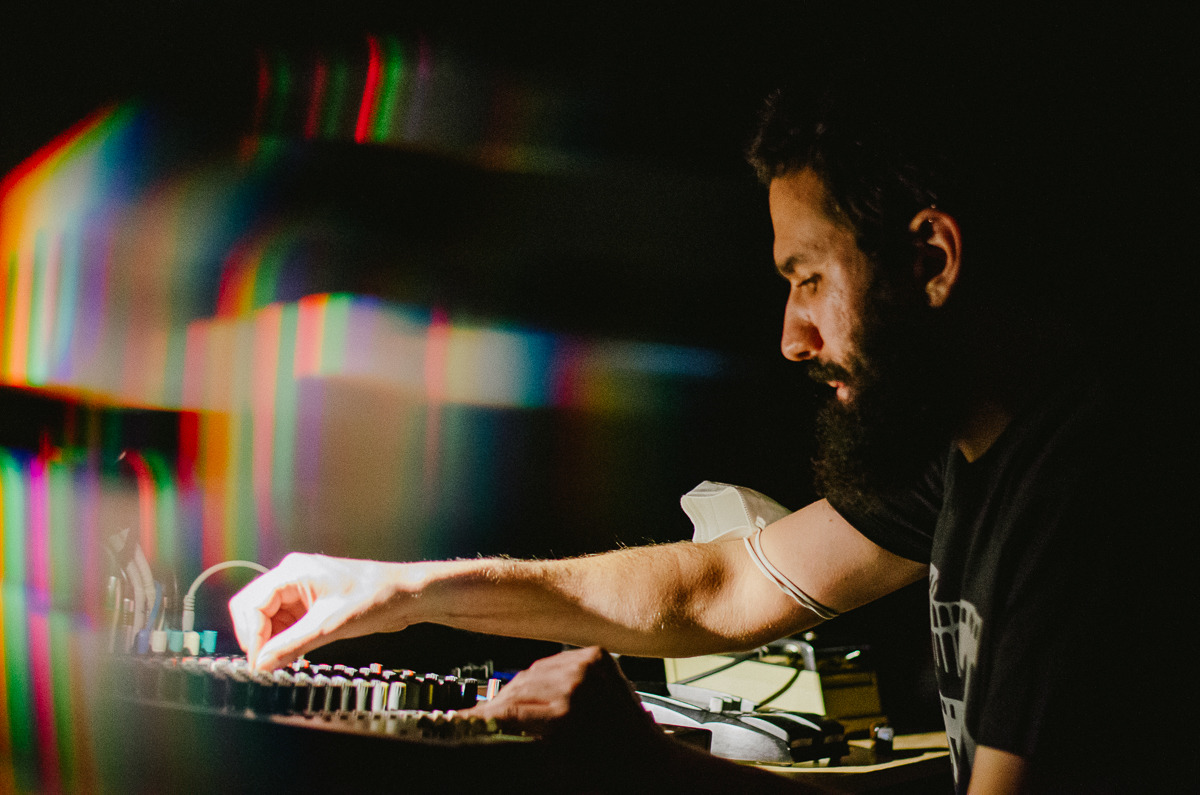
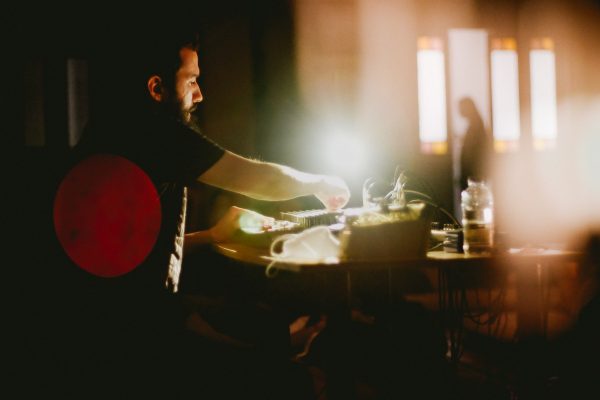
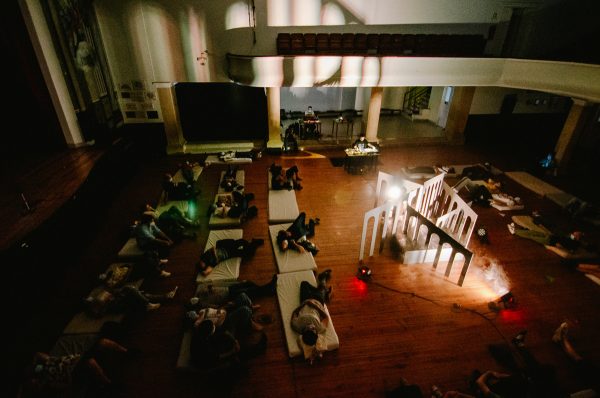
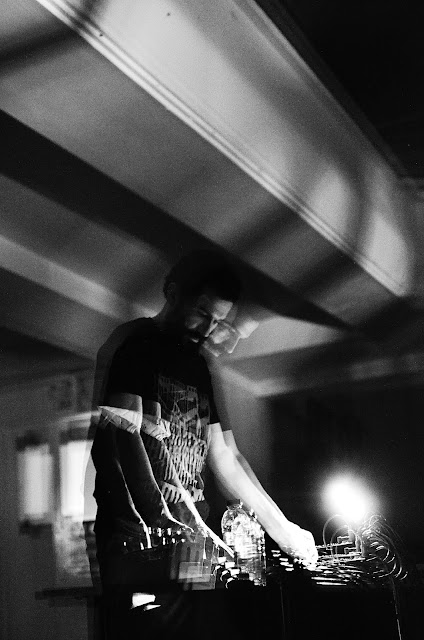
João Sarnadas, aka Coelho Radioactivo, was the man in charge of opening the last day of the second moment of OUT.FEST 2021, presenting a deep listening experience intimately connected to that of his debut work under his own name, the two double albums "The Hum" & "The Humm". At SDUB "Os Franceses" we were able to listen to two hours of electronic improvisation rich in harmony and texture in the perfect conditions for doing so: lying down, eyes closed, absorbing the sound.
We also had the chance to speak with the artist before and after the concert, and it is the compiled result of those interviews we present to you below.
Interview by Tiago Franco. Photos by Nuno Bernardo and Pedro Roque (in black and white).
What was your first contact with this kind of long-form, minimal music?
Hi hi. I always loved long music, not necessarily in terms of its duration but more of its composition, and the use of continuous sounds, for many reasons, including the fact that often there’s some sort of drama associated with long music like that and that drama is something I relate to easily. Thinking about it on the spot, I’d say my first contacts with long-form minimal music happened with artists who aren’t particularly “durational” or minimal, the first pieces I recall are “Back to Schinzo” by Pascal Comelade and “Stranger Intro” by Bill Frisell (the intro for a Marianne Faithfull album) which were songs I heard a lot when I was a kid. Pascal is one of my favourite musicians ever, and fortunately he has enough albums to be able to constantly hear new things from him, I only discovered his first, more experimental albums around 5 years ago. “Stranger Intro” is a 30 second loop that I heard on repeat, and I decided to make a version of it for this album, although when I made it I didn’t necessarily know it would become part of an album, I only wanted to try playing it in order to listen to what a version with more than 30 seconds could sound like, and it ended up turning into D1 M Bombarda Transmission. When it comes to more intellectual stuff, I think the first long-form minimal musician I got into was La Monte Young, then maybe Terry Riley’s concert with Don Cherry in Köln. But I don’t know if these were my inspiration to make this album, especially because this long form comes more from the way I play than from a prior decision to do so. Those are obviously musicians I enjoy, so they ended up influencing my melodies and my thoughts, but I think the music is always the result of a much wider range of influences.
Could you tell me a bit about the equipment you use on this album? It was built by Inês Castanheira, who runs a DIY synthesizer workshop. Was it a commission or was it given to you with the three oscilators?
Yes, the synthesizer I used on this album and the one I now use live is a simple one, with three oscillators and three on/off switches, made by Inês Castanheira. I’m fortunate enough to share not only my life but also my house with Inês, so I have easy access to the things she builds, and this one in particular is one of the first she built, because she was starting to explore synthesizer-building at the time, and that’s precisely the reason why it’s so simple. We started using this synth and another one in a project we both have called Well, and I eventually started using it in collective pieces by Favela Discos, such as the “Desilusão Óptica” piece. That was the background I had in developing the approach to the material I created for this album, based on the use of this synthesizer, the mixer, loops and other effects pedals.
You recorded this album in two days, which resulted in 8 hours of recordings, and it took you three years to mix it down to two albums of two hours each. What kind of methods did you use to bring it down to that size and what kind of challenges did you encounter in the cutting room?
Well, at the time when I did that recording session, I didn’t really have the idea of making an album out of it. As I said previously, I simply felt that I had arrived at a different way of playing from what I did as Coelho Radioactivo, for instance, and that I wanted to record something using that “language”. I actually feel like The Hum has something of Coelho Radioactive in it, I think that the melodies have something to do with that universe, as does the use of loops, which was something I did often both live and when playing by myself at home. At the time I had Nuno Loureiro’s mixer at my house, because I had used it at a Desilusão Óptica concert, and so I took the chance and started recording for two days, which as you mentioned resulted in 8 hours of music. It was actually more, around 11 hours, but I usually don’t count those hours because they weren’t that great to begin with. Basically, the biggest challenge was to understand the results I came up with, which led to two problems – first to reduce the music to a more acceptable length to make them understandable as “songs”, and second to figure out what those songs were, if they’d lead to three albums, to one, to two…which way to order them made sense…Eventually I managed to simplify it into two albums, one which was more “drone” and a more “ambient” one, or a more “atonal” and a more “melodic” one, a “daytime” album and a “nightime” album, but over those three years I started grouping the music with really quite different concepts, which probably aren’t that clear but which helped me understand what these songs were.
I read somewhere that you took cues from “the unique harmony of each city you lived in”, could you tell me a bit about that? Do you see any crossover between your music and architecture?
Well, in fact, even through it was inspired by things I feel about the record, the process, and my thoughts when I was making it, that’s a bit of press mumbo-jumbo. I’m always torn between conceptualizing the music I make or not, I usually don’t make things following a pre-defined concept, the only thing I’m interested when I’m recording is my intuition, and if I’m enjoying the music I’m creating. However, on the other hand, I’m interested in thinking about sound, and it’s something I do on my day-to-day for various reasons, either simply because of reading things about music and sound, or due to communicating about what I do solo or with the people I work with on a day to day basis – for instance, with the rest of the guys at Favela Discos when we develop collective pieces – we obviously need to speak about what we want to do, and either you want to conceptualize what you do or not you always end up having some thoughts about what you are doing. In that sense, something I’m interested in, for instance, is the relationship between ambiguity and deep listening. In the same way you can, with deep listening, discover melodies, rhythms, tones, etc in the soundscapes of a city, you can also discover new sound layers in the kind of music I make, in between the more obvious melodies you can discover other melodies, like you can distinguish them in the middle of the mass of sound and noise. In that sense, I think the relationship with the city soundscapes is that one, discovering some musical logic in the midst of the mass of sound we’re exposed to, between cars, fans and turbines, those noisy air conditioning things, and all the other things that make up the sound floor and which we sometimes don’t even notice.
The global phenomenon of ‘The Hum’, with tales of people who are almost chased by ultra-low frequencies in residential or industrial zones, is considered an unpleasant sound, one that leads to insomnia and headaches. Those are the last things I’d mention when describing your music. Does the album try to redeem this type of sound and put it in a different context, in a way?
Well, first of all thanks for the compliment. Regarding The Hum phenomenon, I think it’s unpleasant because it’s a sound that is an undesired and permanent intruder, but maybe that sound would be acceptable in an experimental music context (laughs). My idea isn’t so much to redeem the phenomenon, I simply think I adopted the name as a more encompassing term, like I said above, I think my The Hum is more about the sound of cities which isn’t immediately perceptible to us. This phenomenon isn’t audible to everyone, apparently some people are more susceptible to it than others. So, I wasn’t interested in talking about a violent, people-chasing sound, but simply about a sound which we only perceive when we become aware of its existence, or something like that. I’m interested in the idea, but not so much in the text-book definition of the concept, and like the music, one of the main reasons I chose the name was due to my intuition, I liked the mystic aspect of the idea and it looked like a cool name. Besides, I also used this theme and title for a comic book released by O Panda Gordo in 2016 or 2017, and at the time I thought it would be cool to connect the two things because they work on the same idea in very different ways.

How different is the album and the music when you play it live? Did you make any adjustments for the OUT.FEST concert?
Well, I’m not actually playing the music on the album, what I’m doing is using the same means and techniques to create new music. The album was created through improvisation, which is what I do live, although lately I’ve been bringing along some pre-recorded loops so it isn’t as boring. During rehearsals I tried to replicate some of the music on the album, but I wasn’t a fan of the result, since I was concerned with make the music sound like the album it ended up sounding like a cheap copy of it, which both wasn’t identical to it or as interesting as it. So I thought the best thing to do was to simply use the techniques I used on the album to create something new, which isn’t what’s on the record but is a part of it, in a way. For OUT.FEST, the only special thing I did was to select some pre-recorded loops, but the concert preparation was all very chaotic because it was the first time I used the scenography and it was all a bit last minute. I think the biggest adjustment I made for this concert was to use the “city” prop, or whatever you want to call it, which was something I wanted to do since the beginning but hadn’t had a chance to, and I was very happy with the result.
Leonardo Bindilatti é o vencedor da Bolsa de Criação OUT.RA para 2023. Co-fundador da Cafetra Records, baterista dos incríveis Putas Bêbadas, metade dos queridos Iguanas, solo master beatmaker enquanto Rabu […]
Desempenho de funções de coordenação de comunicação, integrando a equipa permanente da associação, assegurando, em articulação com a direção artística e com o responsável pelo arquivo media e produção vídeo, […]
The 19th OUT.FEST will take place on 5-7 October of this year. We return to Barreiro with the best annual meeting point to delve into the various possible worlds of Sound and to celebrate the miracles of Music, to explore the city and (re)experience community as a space of liberty.
OUT.RA is once again accepting applications from local artists to develop creative work related to Music / Sound / Sound Arts / Multimedia during 2023.