Leonardo Bindilatti é o vencedor da Bolsa de Criação OUT.RA para 2023. Co-fundador da Cafetra Records, baterista dos incríveis Putas Bêbadas, metade dos queridos Iguanas, solo master beatmaker enquanto Rabu […]

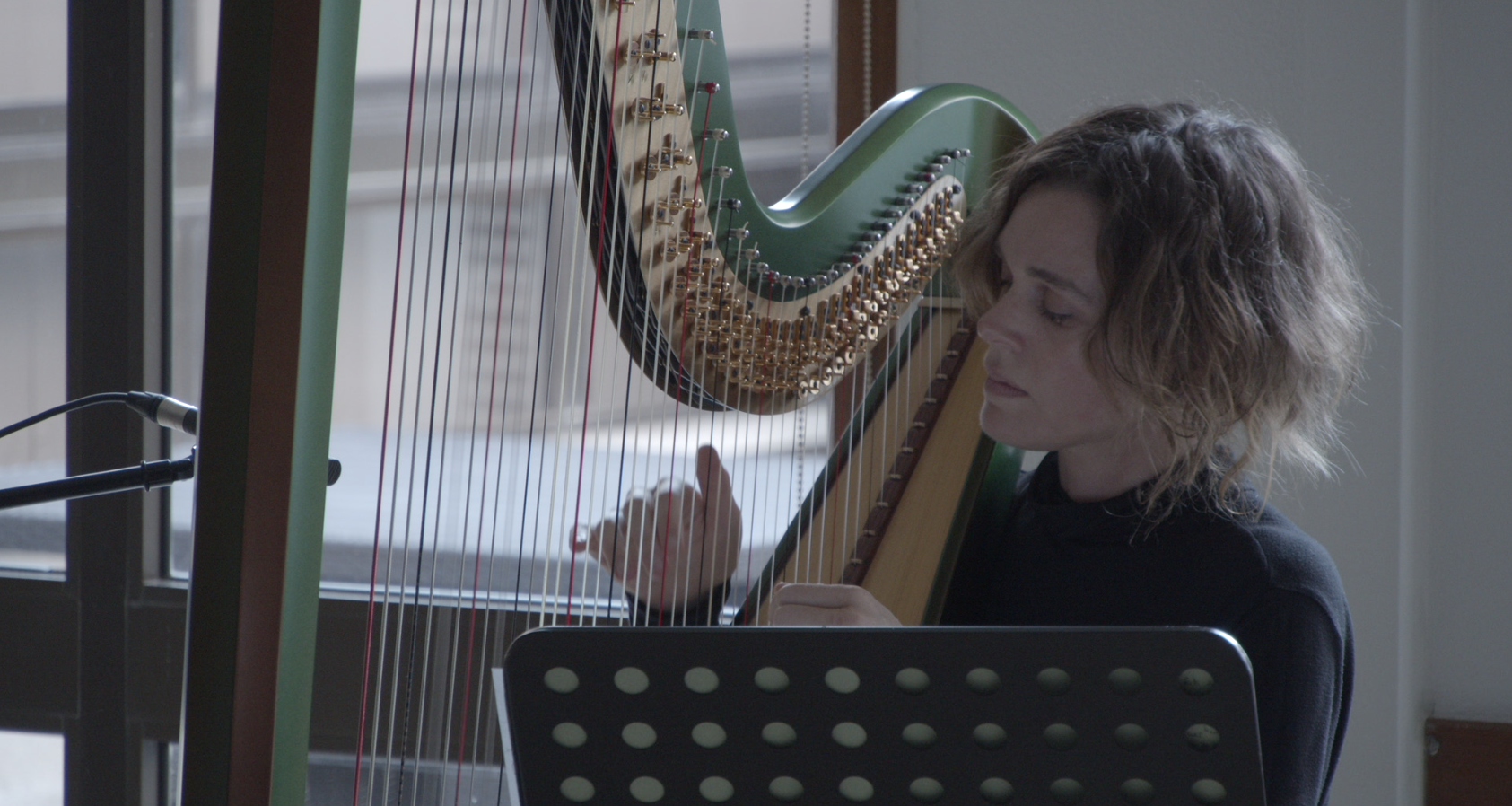
Angélica Salvi is a Spanish harpist who’s been based in Porto for a few years and who has produced exploratory work with her instrument with a truly heterogeneous variety of musical and transdisciplinary collaborators, albeit essentially focused on improvisation work. In addition to teaching at the local Music Conservatory, she has performed as a soloist with the Porto Casa da Música Symphonic Orchestra and the celebrated Remix Ensemble.
In her collaborations with iconic musicians such as Han Bennink and Evan Parker, in her work on stage and in her records, her vocabulary is ever adapting, though always maintaining its identity, working the timbres and effects according to contexts and ideas.
We had the chance to speak with her before her performance at OUT.FEST 2019, and we invite you to read the result of that conversation below.
When and why did you move to Portugal? What made you head to Porto, specifically?
I was living in the Netherlands, where I was studying, and I received an e-mail from one of my teachers saying that they needed someone to teach the harp at the Porto Conservatory and asked me if I was available. I thought, why not? So, in September 2011 I moved to Porto, going to the Netherlands once a month to finish the Masters’ degree I had started there.
How long ago did you start playing the harp?
I play it since I was 11.
And what made you focus on this specific instrument?
It was a coincidence. At the time I had started studying the piano. I went through the tests to study at the conservatory and when I was accepted, I chose the piano as my first option and the harp as the second (because it was the closest instrument to the piano). There weren’t any openings for the piano class, so I started studying the harp. And I liked it, even though I didn’t know the instrument well at the time.
It’s your main instrument, but was there any time you decided to change instruments, or were captivated by another one?
I had a piano at home (my mother studied and played the piano) and there was a time when I played both the piano and the harp, and in my opinion both instruments have a lot in common. Even though I like other instruments besides these two a lot, I never decided to seriously focus on any of them.
When did your interest in improvisation begin? It’s not usually something that’s taught in schools, especially for the harp…was there any moment, or an idea, artist or concert which led you to this approach to music?
Well, I was always very interested in creative, artistic pursuits in general. I studied fine arts for three years, I love drawing and always liked making up new things. At school I had a very conservative education (though fortunately they changed it up a little later on) so I had to search and explore on my own. I was looking for some kind of freedom and the only alternative I found at the time (which went beyond written music) was Jazz. I had some jazz lessons, I met a harp teacher who taught jazz at the University of Arizona and I studied under her for a year and a half. Then I continued my studies in the Netherlands, at the Conservatory and the Dutch Impro Academy, where I met the ICP Orchestra musicians and the Brokken-Fabriek (in Amsterdam) and that’s when I discovered the world of free jazz. So, I’ve been active in improvisation for several years now.
I spoke with Peter Evans a few days ago and he told me he always finds it difficult to teach people the “right” way to play music, and that his way of teaching is not so much to show how you “should” do something, but rather to serve as a guide to new musical possibilities. Do you share some of his doubts about the best way to teach music and the harp in particular? How do you guide your students in their learning?
I always have many doubts…As teachers we’re always learning from our students. I also speak with many colleagues and my students often so we can try new methods and formulas. Some of my students are very young, so I have to find a balance between the creative and theoretical parts. On one hand they have to learn the theory (even if that may be a little repetitive and monotonous at times) in order to be able to reach a certain technical and positional level required to master the instrument. Sometimes it can get complicated because it requires a lot of patience and consistency. It’s kind of like a martial art.
Searching for that balance is the difficult part. It also depends on the specific person and their personality, so it’s important to adapt the classes to each student and understand what they like or what they feel more comfortable with.
But other than that yes, I agree with Peter Evans: a teacher should serve as a guide to new musical possibilities!
Do you have any new projects which you’d like to tell us about?
I have several ongoing projects, they’re all on my website: www.angelicasalvi.net.
You’ve collaborated with several Portuguese musicians, like Rafael Toral – do you feel as if there’s a way of seeing music – particularly improvised music – which is unique to Portugal? Of course everyone has their own personality, but do you think there’s something special about this community in Portugal and their approach to music?
You’ve collaborated with several Portuguese musicians, like Rafael Toral – do you feel as if there’s a way of seeing music – particularly improvised music – which is unique to Portugal? Of course everyone has their own personality, but do you think there’s something special about this community in Portugal and their approach to music?
Tinha a sensação, sobretudo quando morava na Holanda, que nos últimos tempos há uma tendência para a especialização: na educação, nas artes... parece que um artista tem de ter um estilo muito específico predefinido, até com certas regras para conseguir encaixar em algum lado ou ter uma etiqueta (muitas editoras fazem pressão constante aos artistas com este tipo de coisas). Penso que isto é um caminho errado porque o resultado acaba por ficar formatado, globalizado e aborrecido... por isso sinto-me muito feliz neste país, penso que os artistas conservam e protegem muito a sua essência e acreditam mesmo em aquilo que fazem. Esta é a experiência que tive com o circulo de músicos que me adotaram.
Interview by: Tiago Franco
Leonardo Bindilatti é o vencedor da Bolsa de Criação OUT.RA para 2023. Co-fundador da Cafetra Records, baterista dos incríveis Putas Bêbadas, metade dos queridos Iguanas, solo master beatmaker enquanto Rabu […]
Desempenho de funções de coordenação de comunicação, integrando a equipa permanente da associação, assegurando, em articulação com a direção artística e com o responsável pelo arquivo media e produção vídeo, […]
The 19th OUT.FEST will take place on 5-7 October of this year. We return to Barreiro with the best annual meeting point to delve into the various possible worlds of Sound and to celebrate the miracles of Music, to explore the city and (re)experience community as a space of liberty.
OUT.RA is once again accepting applications from local artists to develop creative work related to Music / Sound / Sound Arts / Multimedia during 2023.