Leonardo Bindilatti é o vencedor da Bolsa de Criação OUT.RA para 2023. Co-fundador da Cafetra Records, baterista dos incríveis Putas Bêbadas, metade dos queridos Iguanas, solo master beatmaker enquanto Rabu […]

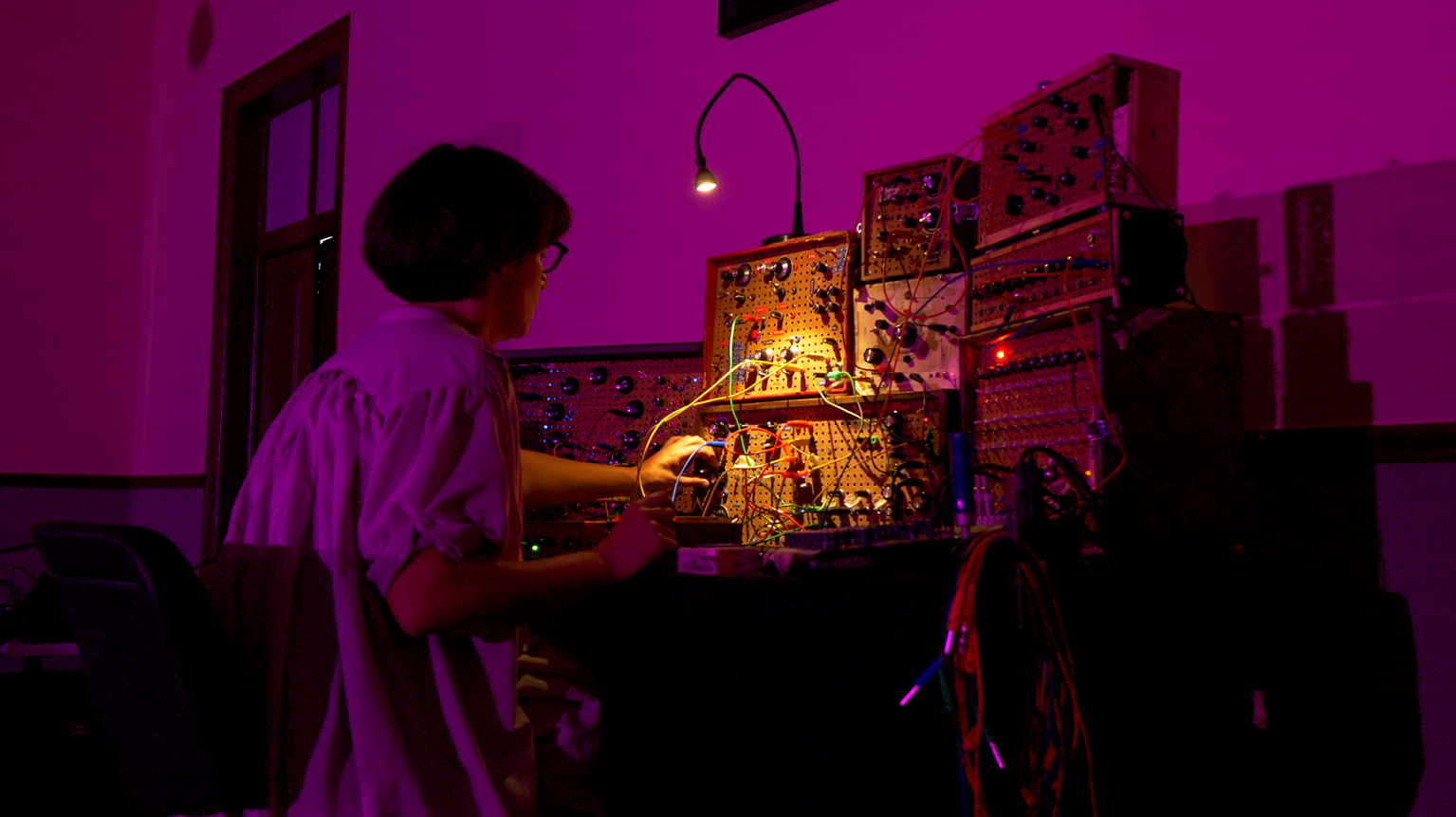
Clothilde é o alter-ego musical de Sofia Mestre, colorista, fotógrafa, desenhadora e não só, que se encontrou enquanto música na viragem para os 40. Trabalha a partir da herança de pós-minimalistas, improvisadoras e compositoras de mente aberta, como Pauline Oliveros, Maryanne Amacher, Daphne Oram, Eliane Radigue ou Delia Derbyshire, para criar a partir de bases electrónicas modulares – tecnologia feita pelo seu companheiro Zé, aka HOBO -, novas paisagens e realidades emocionais e estéticas. Em Outubro de 2018, durante a edição do OUT.FEST desse ano, onde testemunhamos uma bela actuação da artista na Escola de Jazz do Barreiro, o Alexandre Ribeiro e o Vasco Completo tiveram a oportunidade de ter uma curta conversa com os dois - Clothilde e HOBO - sobre o sistema electrónico único que usam e as suas origens, bem como o despertar de Clothilde para a criação músical.
When did you start building this kind of machines?
HOBO: I started thinking about this some six, seven years ago. At the time I was building some machines in cardboard (I always used the materials I had close by to build things) and one of the times I went searching for materials I went to my father’s house, who did radio assembly in Guinea-Bissau during the colonial war, and he had a breadboard and some chips along with some other stuff that he told me to take. I put them in my bag and then it was stored in a drawer for about a year, until I stumbled upon something that reminded me that I had that stuff at home. Then I started building things, first an amplifier in a Scotch-Brite box, very basic stuff, and it grew from there. I started thinking, “Ok, I want to send the sound somewhere, so I need an amplifier.” That was step number one. Number two: we need some oscillators, let’s do it. From there it kept growing, I kept researching, seeing what had been done before and what I could do differently. Nowadays with the internet you can take giant steps with these things – before it was much more complicated, all the information was only in books, but now you make a quick search and you get the gist of what you need to do, and once you learn what’s already been done you take a step back, explore the chip’s technical specifications, and use that knowledge to create your own things. That’s what the process has mostly been like, self-taught and unpretentious, doing it because I enjoy it.
About the specific machines the “machinist” uses, can you take us through how they work?
CLOTHILDE: There’s several of them…
HOBO: We didn’t bring all of them with us…there’s around ten over there, plus some keyboards, and in total we probably have around 20…the idea is that each of these machines should be able to be used independently and make sound on its own, kind of like a modular system but not entirely, because in modular systems you have to carry everything with you, but here if I want to just take one machine I do that and output its signal directly through a jack, or I can use a banana jack to send its sound somewhere else. I wanted it to be very versatile, so that I could play with one, or two, or all of the machines….
C: Foi curioso porque só agora é que podemos tocar juntos – dantes não tínhamos máquinas suficientes para tocar os dois. Eu toco sozinha muito fruto disso - ele tem um projeto com um amigo em que também usa estas máquinas e se tocássemos os dois ao mesmo tempo íamos “desfazer-nos” um ao outro, porque para conseguir certos sons é necessário que elas estejam ligadas entre si, para modular, filtrar, whatever. Mas agora já conseguimos, e o próximo passo é começarmos também a ter um projecto e a tocar juntos.
How did your activity as a musician begin?
C: I’ve always been crazy about music, but I never had the desire to make music, it was proposed to me, because people knew I played with him, and so it happened. We have a house in Meco with friends, for resting, and he [HOBO] would take his machines and we’d play around with them, but I never harboured any ambition of playing in concert one day…
I’ve been friends with Sonja from Labareda, the label I released my album on, for many many years now and she knows me very well – better than myself apparently – and so she challenged me to make something and I was like “You’re crazy…me?”. It wasn’t something I ever even wanted to do before, but I ended up thinking that I couldn’t spend my whole life considering it so…
You’ve recently released your first LP, “Twitcher”…does your career have anything to do with music?
C: Nothing.
Can you tell us a little about that?
C: I’ve always been a fanatic about music, ever since I was little – to the point where I’d start crying if my mother put something on that I didn’t like. It’s true! But I never worked in music.
My grandfather was the drummer for a great jazz band in the twenties, my mother made a tremendous effort to push me towards studying music (she wanted to study it when she was younger but my grandfather wouldn’t let her because she was a girl), my uncle plays everything…so music was always there.
I worked in advertising and cinema for many years, I’ve been a colorist, I like drawing, photographing, now I’m setting up a project with a few friends and we’re still figuring out what’ll come out of that…But this…I made “Birdwatching”, which was what Sonja challenged me for, a compilation, and that’s when I told her “well…I’ll do my best, I promise I won’t let you down, even if it kills me…”, because I’m a little demanding with myself, a little too much so even. Then she started talking about an album, and that made me go “so it’s not just a song anymore, huh?” but I had already passed the first hurdle, I had my first concert at Damas…then I played the second at Lounge, the third at Walk&Talk in the Azores, then at ZDB, by then I was even saying “well damn, there’s only Maria Matos left” (laughs). I don’t know what happened, I wasn’t expecting it, but I know I have an ear for music, I know everything’s here. I don’t count the measures, I feel them, it’s a lifetime of listening to music with a lot of passion reflected here. I made the album (the release party was on May 25th) and strangely it came out well. I was very happy, I didn’t know what was going to come out…
How has it been received so far?
C: It’s been insane, I don’t have the time to be an artist… (laughs) Just last month I had three concerts, at Festival Exquisito on the 13th, at WOS in Santiago de Compostela on the 15th, then in Porto in Passos Manuel on the 22nd, in a night organized by Fungo where Zé [HOBO] played with Marco (o Citizen:Kane), because we couldn’t play together, plus Nuno Patrício and Nicolai, the Fungo DJs, we all played and now I’m here. And meanwhile I have several proposals to answer…even as far as 2020, and I get really nervous with those things, I don’t even know if I’ll be alive then (laughs). But it’s a super interesting project and I think it’s totally my thing, because it’s a theatre play.
Leonardo Bindilatti é o vencedor da Bolsa de Criação OUT.RA para 2023. Co-fundador da Cafetra Records, baterista dos incríveis Putas Bêbadas, metade dos queridos Iguanas, solo master beatmaker enquanto Rabu […]
Desempenho de funções de coordenação de comunicação, integrando a equipa permanente da associação, assegurando, em articulação com a direção artística e com o responsável pelo arquivo media e produção vídeo, […]
The 19th OUT.FEST will take place on 5-7 October of this year. We return to Barreiro with the best annual meeting point to delve into the various possible worlds of Sound and to celebrate the miracles of Music, to explore the city and (re)experience community as a space of liberty.
OUT.RA is once again accepting applications from local artists to develop creative work related to Music / Sound / Sound Arts / Multimedia during 2023.